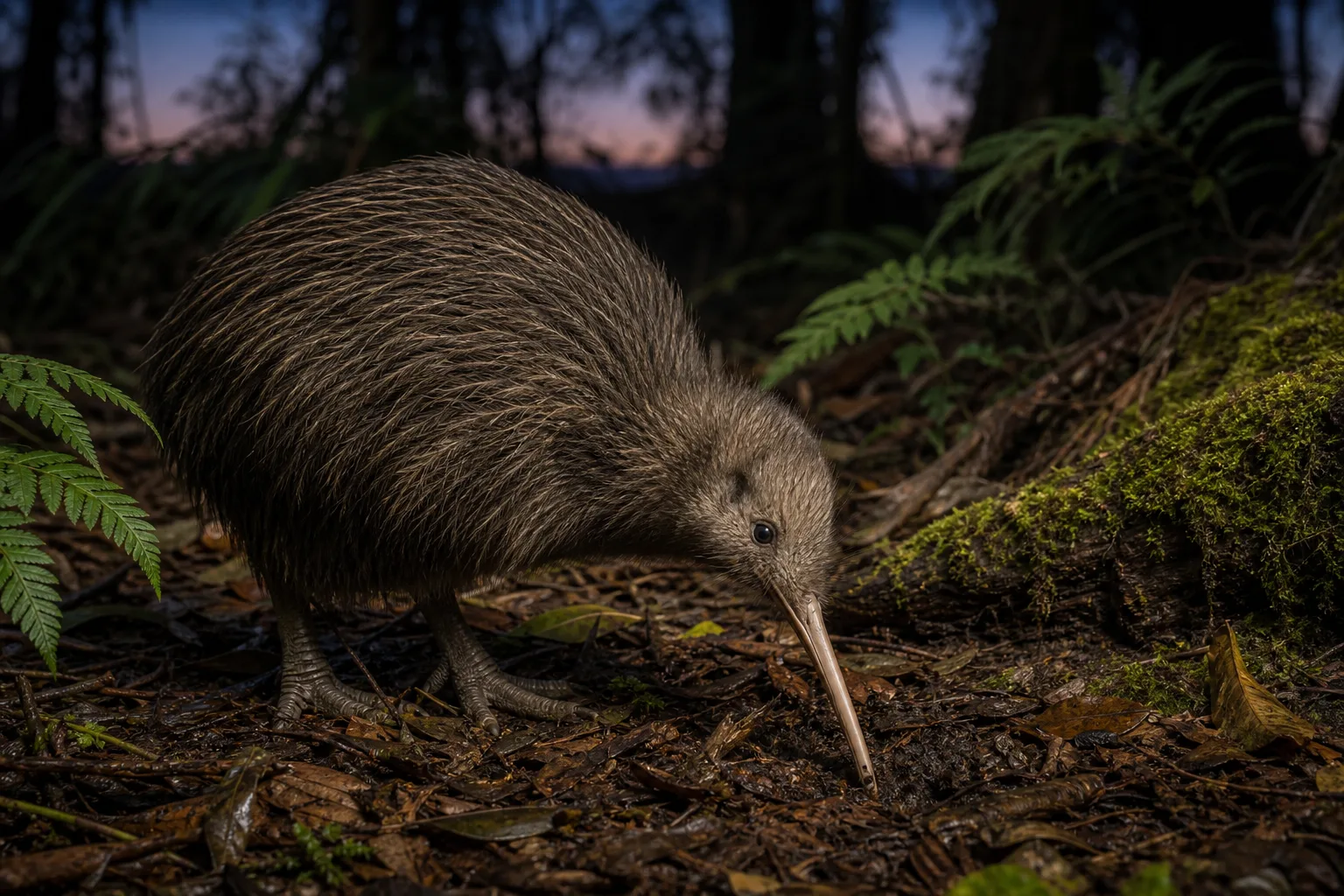
The kiwi bird is a small, flightless bird found naturally only in Aotearoa New Zealand. It is unmistakable for its shaggy, hair-like feathers, long bill with nostrils near the tip, sturdy legs, and mostly nocturnal life. Kiwi are birds despite looking unlike many familiar birds: they have feathers, lay eggs, and belong to the ratite group of flightless birds. Source (accessed 2026-09-08)
Kiwi bird facts at a glance
| Feature | What to know |
|---|---|
| Natural range | Kiwi are endemic to Aotearoa New Zealand; they do not occur there as wild native birds anywhere else. Source (accessed 2026-09-08) |
| Flight | Kiwi are flightless and have very small wings. Source (accessed 2026-09-08) |
| Activity | They are generally nocturnal, using the cover of darkness to forage and move through their habitat. Source (accessed 2026-09-08) |
| Food | Kiwi probe soil and leaf litter for invertebrates and also eat some plant material. Source (accessed 2026-09-08) |
| Recognized species | New Zealand recognizes five kiwi species: North Island brown kiwi, great spotted kiwi, little spotted kiwi, rowi, and tokoeka. Source (accessed 2026-09-08) |
What makes a kiwi so unusual?
A kiwi has adaptations that fit a life on the forest floor. Its loose, bristly-looking feathers provide a very different silhouette from a songbird’s smooth feathering. Its wings are so reduced that they do not support flight. Instead, kiwi rely on strong legs to travel on the ground and a long bill to investigate soil, rotting wood, and leaf litter. Source (accessed 2026-09-08)
One especially useful identification detail is the placement of the nostrils. In kiwi, they sit close to the end of the bill rather than near its base. This helps explain why a feeding kiwi often appears to sniff and probe as it searches for food. Source (accessed 2026-09-08)
Kiwi are ratites, a group that also includes larger flightless birds such as emus and cassowaries. They are distinctive within that group because of their small size, nocturnal habits, and bill-tip nostrils. Source (accessed 2026-09-08)
Where kiwi live
Wild kiwi belong to New Zealand, where different species occupy different regions and habitats. They can use forest and other sheltered landscapes, but the right habitat is only part of the picture: safe places also need protection from introduced mammalian predators. Source (accessed 2026-09-08)
There are kiwi in the United States under managed care, including North Island brown kiwi listed by Smithsonian’s National Zoo. That does not mean kiwi are native to the United States; their natural range is New Zealand. Source (accessed 2026-09-08)
Night foraging, food, and calls
At night, a kiwi moves deliberately through cover, using touch and smell while probing for food. Invertebrates are important prey, and diets can also include fruits, seeds, and other available plant matter. The exact menu changes with species, place, and season. Source (accessed 2026-09-08)
Kiwi are often heard rather than seen. Calls help birds communicate across their territories, and call character varies among species and between individuals. If you record an unfamiliar bird at night, compare the recording cautiously with location, habitat, and time of day rather than identifying it from one sound alone. For a practical listening workflow, see How to Identify Bird Species by Sound and Photo and App for Bird Sounds: Find the Bird Behind the Call.
Eggs, nests, and kiwi chicks
Kiwi eggs are famous because they are exceptionally large relative to the adult bird’s body. Nesting and parental care vary among species, but kiwi typically use sheltered nest sites, and male incubation is an important part of breeding in several species. Source (accessed 2026-09-08) Source (accessed 2026-09-08)
Young kiwi are comparatively well developed when they leave the nest, but that does not make them safe. Predation remains a major obstacle to survival in many places. Source (accessed 2026-09-08)
Why kiwi need protection
Kiwi conservation is urgent because introduced predators, including dogs, stoats, and cats, can kill kiwi or their young. Risk differs by location and species, so it is more accurate to discuss conservation status by species and population than to describe all kiwi in the same way. Source (accessed 2026-09-08)
Conservation work includes predator control, protected areas, monitored populations, and conservation breeding and hatching programmes. The National Kiwi Hatchery describes its role in hatching and caring for kiwi for conservation. Source (accessed 2026-09-08)
If you visit kiwi habitat or a sanctuary, follow local guidance, keep dogs under the rules that apply, and never try to touch or feed a wild kiwi. A calm bird at a managed facility is not evidence that wild kiwi are friendly or appropriate to approach.
A national symbol with living cultural importance
The kiwi is widely recognized as a national symbol of Aotearoa New Zealand. Its importance is not simply visual: the bird has longstanding cultural significance and remains closely linked with New Zealand identity. Source (accessed 2026-09-08)
Identify birds responsibly
A glimpse of a rounded brown bird is rarely enough for a confident identification, especially at dusk. Note the bird’s location, behavior, bill shape, sounds, and any clear photographs, then compare several clues. Our Birds Near Me: How to Figure Out What You’re Hearing article explains how place and sound narrow the possibilities, while the Bird Sound Identifier can help you organize an observation from audio or a photo. Do not use an identification attempt as a reason to get closer to wildlife.
Quick answers about kiwi birds
Can kiwi fly? No; their wings are too small for flight. Why are they special? Their bill-tip nostrils, hair-like feathers, nocturnal ground life, and unusually large egg make them unlike most birds. Are they almost extinct? Kiwi face serious, continuing threats, but risk and conservation status differ among species and populations. Source (accessed 2026-09-08) Source (accessed 2026-09-08)