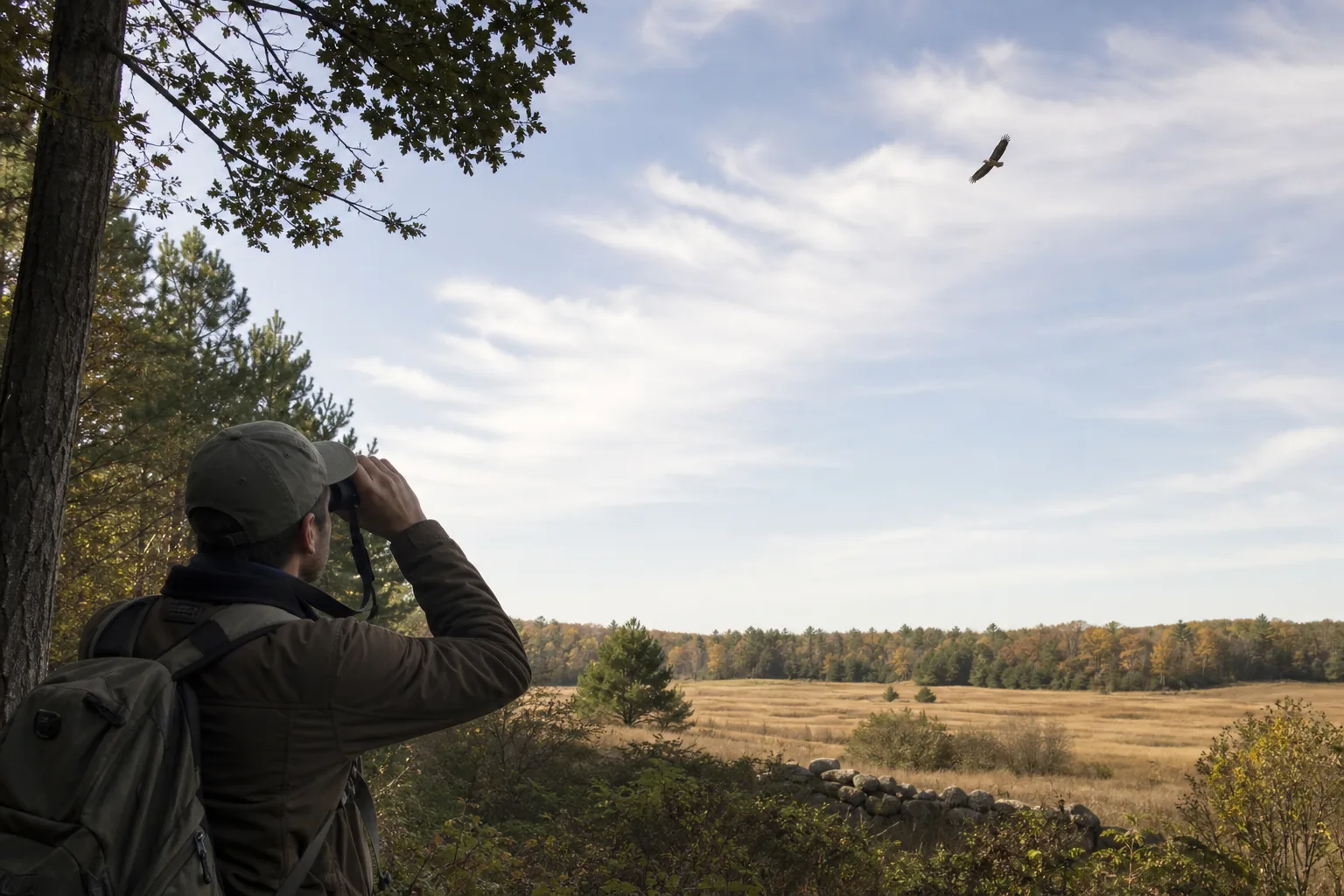
Start with the bird’s shape and flight style, then use its tail, wing shape, and underside pattern to narrow the possibilities. Color can help, but it is often the least dependable first clue: light, distance, age, and angle can change what you think you see. A photo, a note about where the bird was, and a comparison with likely local species make a much stronger identification.
A practical hawk identification process
- Decide whether the bird is soaring, flapping, gliding, or perched.
- Look at the overall silhouette before trying to name colors: broad wings, rounded wings, pointed wings, a long tail, or a compact body can quickly eliminate groups.
- Study the tail in relation to the body. Note its length, outline, and whether it appears barred, pale, dark, or rusty.
- Check the underparts for a belly band, streaked breast, pale throat, dark head, or contrasting patches near the wing or rump.
- Use habitat, season, and behavior to support the visual evidence rather than to make the identification on their own.
- Compare your observation with species expected in your area, and keep an uncertain sighting open when the marks do not agree.
For a record you can revisit, write down what you saw before looking at an identification. Include the bird’s approximate size relative to a familiar nearby bird or object, the setting, its direction of travel, and the marks you could see. A photo is useful even when it is blurry because it may preserve proportions, posture, and wing shape. For ideas on recording visual and sound clues together, see How to Identify Bird Species by Sound and Photo.
Is it a hawk, a falcon, or another raptor?
In everyday North American birding, “hawk” often covers several raptor groups with different shapes and hunting styles. Buteos, such as Red-tailed and Red-shouldered Hawks, tend to look broad-winged and sturdy. Accipiters, such as Cooper’s Hawks, tend to look slimmer, with long tails and relatively short, rounded wings. These are useful starting groups, not a substitute for checking several marks.
Fast comparison clues
-
Hawk: often has broader or more rounded wings than a falcon. Many soar in circles or use rising air, although flight behavior varies by species and situation.
-
Falcon: usually shows long, narrow, pointed wings in flight. A falcon may look more streamlined and often has a sharper, faster wingbeat.
-
Eagle: generally looks larger-headed and heavier-bodied than a typical hawk, with a more imposing silhouette.
-
Vulture: may soar with wings held in a shallow V and can show a very small-looking head. Do not rely on this posture alone.
-
Owl: can be mistaken for a hawk in poor light, but often has a rounder head profile and a softer-looking flight.
A distant bird is often best identified by eliminating groups first. If the wings look strongly pointed, consider a falcon before searching hawk photos. If the bird has broad, plank-like wings and a short-looking tail, consider a buteo. If the tail projects conspicuously beyond the folded wings while perched, an accipiter is worth considering.
Read the silhouette before the plumage
Broad-winged hawks
Broad-winged birds can look sturdy in flight, with wide wings that appear rounded at the outer edge. When they soar, the outer flight feathers may separate into visible “fingers.” The tail can be a valuable feature, but perspective matters: a tail pointed toward you can look shorter than it really is.
Long-tailed, short-winged hawks
Cooper’s Hawk and related accipiters often present a different outline. In a perched view, the tail may be especially noticeable beyond the wing tips. In flight, the wings can look comparatively short and rounded while the long tail acts like a rudder. This shape is especially helpful around wooded neighborhoods, where these birds may move quickly between trees.
Wing feathers and flight style
Look for the pattern of the wing rather than trying to count feathers. A pale panel, dark trailing edge, or contrasting underwing can be useful when clearly seen, but shadows can create false patterns. Note whether the bird repeatedly flaps and glides, circles on spread wings, or powers straight through. Describe the action in your notes; it may become decisive when paired with a photo.
Use the tail carefully
The tail is among the most useful hawk marks because it is visible in both perched and flying birds. Record its shape as well as its color. It may look rounded, squared-off, slightly notched, narrow, or broad. Look for broad bands, many fine bars, a pale tip, or an obvious contrast between the center and outer feathers.
A red or rusty-looking tail can suggest an adult Red-tailed Hawk, but it should not be treated as a standalone answer. A tail can be backlit, shadowed, partly hidden, worn, or seen from below. Young birds may also lack an adult-like tail appearance. Compare the tail with wing shape and the pattern across the belly before settling on a name.
Plumage marks that can confirm an identification
-
Belly pattern: a concentrated band or patch of streaking can be more useful than general brown coloration.
-
Breast and throat: note whether the throat is pale, whether streaking is fine or heavy, and whether the breast is clear or marked.
-
Head pattern: observe a dark cap, pale eyebrow, cheek contrast, or a more uniform head.
-
Rump and upper tail: a pale or contrasting rump can be visible as the bird turns away.
-
Underwing contrast: look for darker edges, darker wrist areas, or pale translucent areas, but treat these with care in strong sunlight.
Age, molt, feather wear, and individual variation can all change these features. Females and males may overlap substantially in appearance, and a bird seen only from below cannot always be identified to species. When the view is incomplete, “buteo species” or “accipiter species” can be an accurate and useful conclusion.
Common hawks to compare in North America
Red-tailed Hawk
Think broad wings, a robust silhouette, and a tail that may appear reddish in many adults. The underparts can show a darker belly area, but plumage is variable. This hawk is often seen soaring over open country, roadsides, fields, and suburban edges. Check the entire shape and underside pattern rather than relying on the tail alone.
Red-shouldered Hawk
Look for a slimmer, more patterned impression than a typical Red-tailed Hawk, with a relatively long tail and noticeable barring when the view is good. It is often associated with wooded habitat, especially where water is nearby, though habitat should only guide your comparison. In flight, contrast in the wing and tail can be helpful if visible.
Cooper’s Hawk
A long tail, compact wings, and a quick, agile flight through trees are useful clues. Around a feeder or backyard, a Cooper’s Hawk may cause smaller birds to scatter, but that behavior alone does not identify it. Compare it with other accipiters and look for proportions before deciding.
Other likely comparisons
Sharp-shinned Hawks can resemble Cooper’s Hawks, while broad-winged buteos and regional species may overlap in silhouette. Location matters here: a species that is common in one region or season may be unlikely in another. Use a local bird checklist, recent observations, or experienced regional birders to test an initial identification rather than forcing an unfamiliar bird into the nearest match.
Perched birds and flying birds need different approaches
When the hawk is perched
Use posture and proportions. Does the tail extend well beyond the folded wings? Is the bird upright and long-bodied, or thickset with a large head? Check the tail outline, head pattern, breast markings, and where it is perched. A fencepost over open ground and a concealed branch in dense trees provide context, but neither setting proves the species.
When the hawk is in flight
Prioritize silhouette, wing posture, tail shape, and movement. Watch for more than a moment if you can. A bird banking may reveal different underwing and upperwing patterns, while a bird flying directly away may make tail proportions easier to judge. If possible, take a burst of photos without losing sight of the bird; one frame may show the key angle.
Why a hawk can look different from one moment to the next
Lighting can turn warm feathers gray, make a pale bird look dark, or erase fine barring. Distance reduces detail, and viewing a bird from below changes the apparent wing and tail proportions. Juveniles can differ markedly from adults, while molt and worn feathers can make an individual look uneven or oddly patterned. These are reasons to describe the marks you observed, not reasons to guess more confidently.
What does a hawk near a home mean?
It usually means the area offers a perch, cover, prey, or a route through suitable habitat. It does not necessarily indicate that the hawk is targeting a particular yard or pet. Give the bird space, avoid approaching a nest or roost, and supervise small animals outdoors when a raptor is active nearby. Bringing very small pets inside or keeping them close is a sensible precaution, but avoid sensational assumptions about what a hawk will do.
Document the sighting, then seek confirmation
Save the original photo and note the place, date, habitat, weather, and behavior. A call can also be useful evidence when it was clearly associated with the bird, though sound should be compared carefully because nearby birds may be vocalizing at the same time. You can explore sound-based comparison with the Bird Sound Identifier or read App for Bird Sounds: Find the Bird Behind the Call.
For sightings near home, Birds Near Me: How to Figure Out What You’re Hearing can help you build a better local observation habit. Keep a running record in a notebook or photo library, and compare uncertain birds over time. The Bird Identification Journal has more field-identification reading when you are ready to practice with other species.
The best hawk identification is the one supported by several independent clues: shape, tail, wings, pattern, behavior, place, and a clear record of what you actually saw.