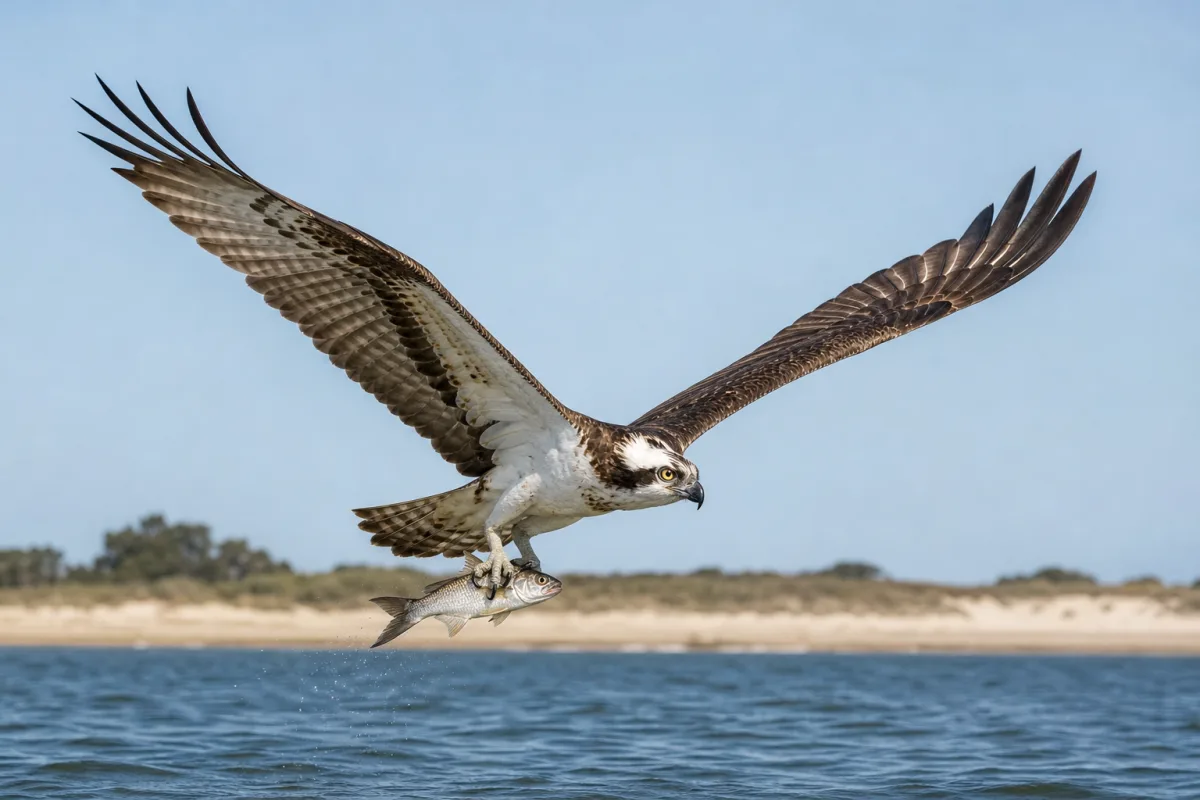
An osprey (Pandion haliaetus) is a fish-eating bird of prey often called a fish hawk, sea hawk, or river hawk. It is most easily recognized near water by its bright white underparts, dark eye stripe, long narrow wings, and dramatic feet-first dives for fish. Source (accessed 2026-10-23)
Look for an osprey over lakes, rivers, marshes, estuaries, reservoirs, and coasts. A bird hovering or steadily circling above open water before plunging down is a strong clue—but use its shape and markings too. Ospreys are widespread, and their close association with fish-bearing water makes them one of the more approachable raptors to watch. Source (accessed 2026-10-23)
How to identify an osprey bird
At a distance, the osprey’s silhouette is often the best starting point. Its wings are long, slender, and noticeably bent at the wrist. In a glide, they can suggest a shallow M shape. The body looks comparatively slim for such a large raptor, and the head can look small and white against the darker upperwings. Source (accessed 2026-10-23)
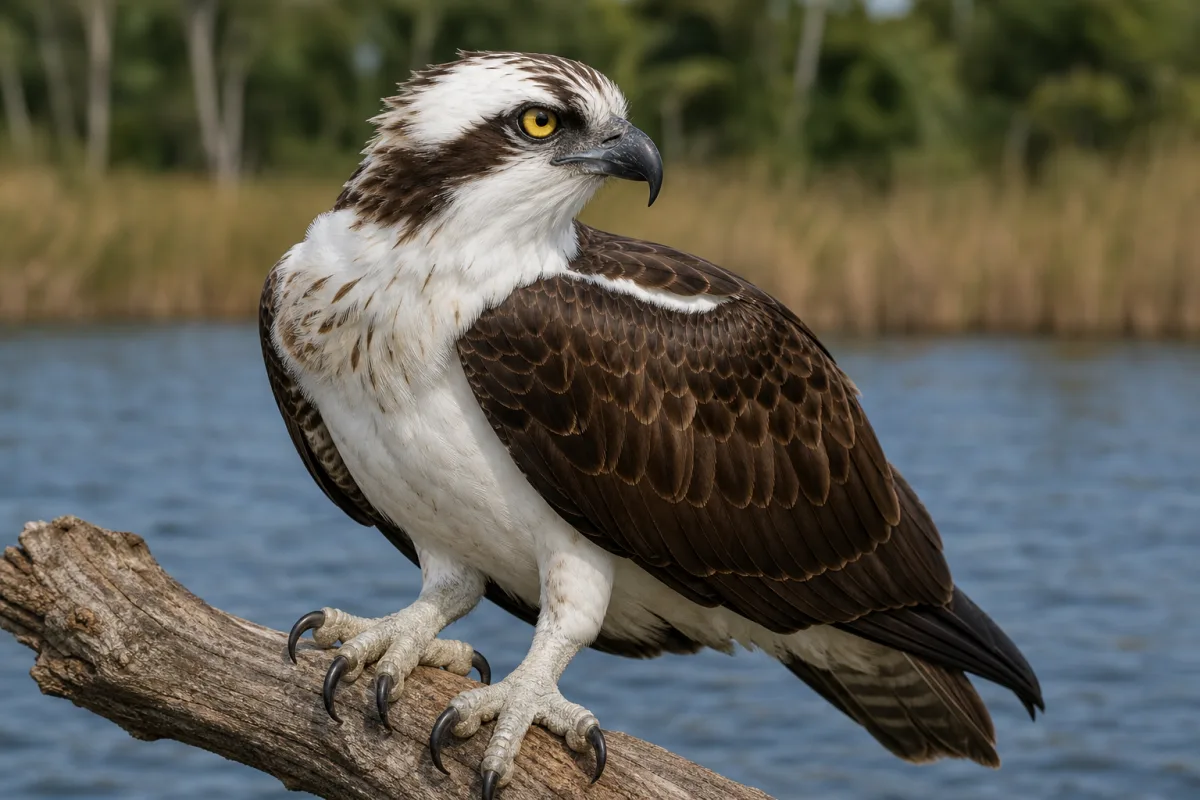
- Head: White crown and cheeks with a broad dark stripe running through the yellow eye.
- Underparts: Mostly pale or white below, sometimes with a variable brown band across the upper breast.
- Upperparts: Brown above, with darker wing patches that stand out in flight.
- Feet: Large, pale feet with powerful curved talons, well suited to holding slippery prey.
- Setting: Usually near water with visible fish, rather than over dry grassland or woodland.
Females often show a stronger breast band than males, but this is not dependable enough to identify every individual by sex. Young birds can show pale edging on upperpart feathers, creating a more scalloped look than many adults. Source (accessed 2026-10-23)
Osprey, eagle, or hawk?
An osprey is a raptor, but it is not an eagle or a typical hawk in the everyday birding sense. It belongs to its own family, Pandionidae. “Fish hawk” is a common name that describes its habits, not its formal classification. Source (accessed 2026-10-23)
| Feature | Osprey | Many eagles | Many hawks |
|---|---|---|---|
| Typical hunting setting | Over open water | Varies by species and habitat | Often fields, woodland edges, or open country |
| Flight impression | Long, narrow, angled wings | Broader wings and heavier-looking body | Usually shorter, broader wings than an osprey |
| Face pattern | Prominent dark eye stripe | Depends on species | Depends on species |
| Food specialization | Mostly live fish | Broadly variable | Broadly variable |
These are field cues, not absolute rules. A distant bird can be difficult to judge in poor light, and regional species differ. When possible, combine shape, habitat, behavior, and a clear view of the head pattern. For a broader look at raptor field marks, see Hawk Identification: Field Marks That Help.
Why ospreys are such effective fishers
Fish make up the main part of an osprey’s diet. The bird searches while flying or hovering, then dives feet first toward the water. Its specialized feet include rough soles that help grip prey, and an outer toe can be turned to help carry a fish in a more streamlined orientation. Source (accessed 2026-10-23)
An osprey may become partly submerged during a catch and can work its way back to the surface. That does not mean it is a waterbird designed to swim long distances; it is a flying raptor whose fishing technique can put it briefly in the water. Source (accessed 2026-10-23)
Where ospreys live and when to look
Ospreys have a very broad global distribution and occur across much of North America. In North America, they are familiar around shorelines and inland waterways where fish are available and nesting sites are nearby. Depending on the region, a sighting may be a local breeder, a migrant passing through, or a bird present outside the breeding season. Source (accessed 2026-10-23)
They are common enough to be regular sightings in many suitable places, so seeing an osprey is not inherently rare. Local abundance still depends on habitat, season, water conditions, and whether nesting structures are available. Scan open water from a safe shoreline, watch for a pale bird flying with strongly angled wings, and check tall poles, dead trees, platforms, and other elevated structures for large stick nests. Source (accessed 2026-10-23)
Many northern breeding populations migrate, while birds in warmer parts of the range may remain nearer to their breeding areas throughout the year. Seasonal timing varies substantially by location, so local bird reports can be more useful than a general calendar. Source (accessed 2026-10-23)
Nests, young, and family life
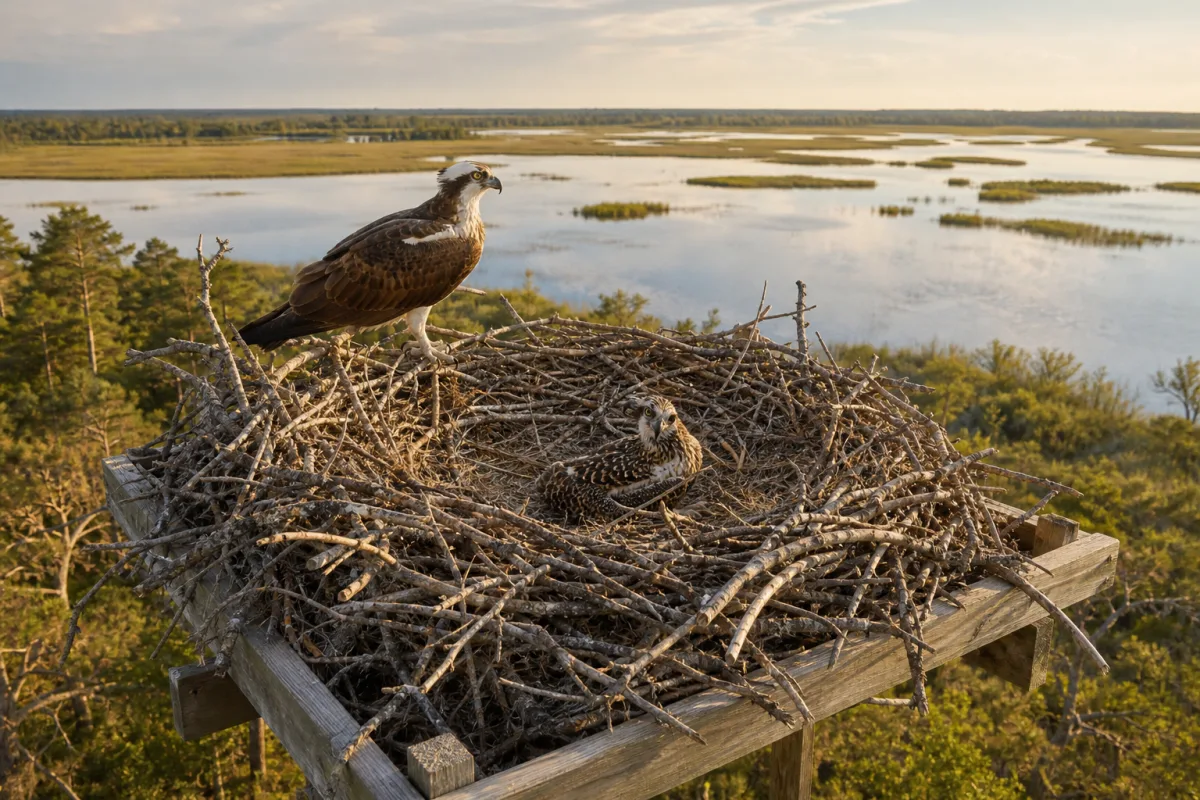
Ospreys build bulky stick nests in elevated, open locations. Natural nest sites include tall trees, while poles, channel markers, and purpose-built platforms can also be used. Both members of a pair contribute to nesting and care for the young, with the male commonly bringing food while the female spends more time at the nest during incubation and early chick care. Source (accessed 2026-10-23)
A baby osprey is a chick. Newly hatched chicks are downy; as they grow, young birds develop brown-and-white plumage and can appear more heavily scaled above because of pale feather edges. They gradually gain flight skills after leaving the nest, so a young bird calling repeatedly from a perch or making uncertain practice flights may still be dependent on adults. Source (accessed 2026-10-23)
What makes the osprey unusual?
The osprey’s specialization is its defining trait: few raptors are so closely tied to catching live fish from open water. Its reversible outer toe, gripping foot surface, long wings, dark eye stripe, and plunge-diving behavior form an unusually coherent set of adaptations for that task. Source (accessed 2026-10-23)
If you hear an unfamiliar bird around a lake or shoreline, sound can complement what you see—but a visual identification should rely on multiple field marks, especially for a distant raptor. Orniqa is described in its App Store listing as a bird sound identifier. You can also read How to Identify Bird Species by Sound and Photo or browse the Bird Identification Journal for observation tips. Source (accessed 2026-10-23)
Quick osprey sighting check
Ask whether the bird is over fish-bearing water, whether it has long angled wings and pale underparts, whether a dark eye stripe is visible, and whether it is watching or diving toward the water. A match across several clues is stronger than any single feature.